Get a post-graduate work permit for up to three years if you are a full-time UBC international student graduating from a bachelor’s degree program and meet all eligibility criteria.
Want to learn more?
Visit the Faculty of Applied Science (Engineering) website to learn more about Mining Engineering.
View full program detailsProgram information
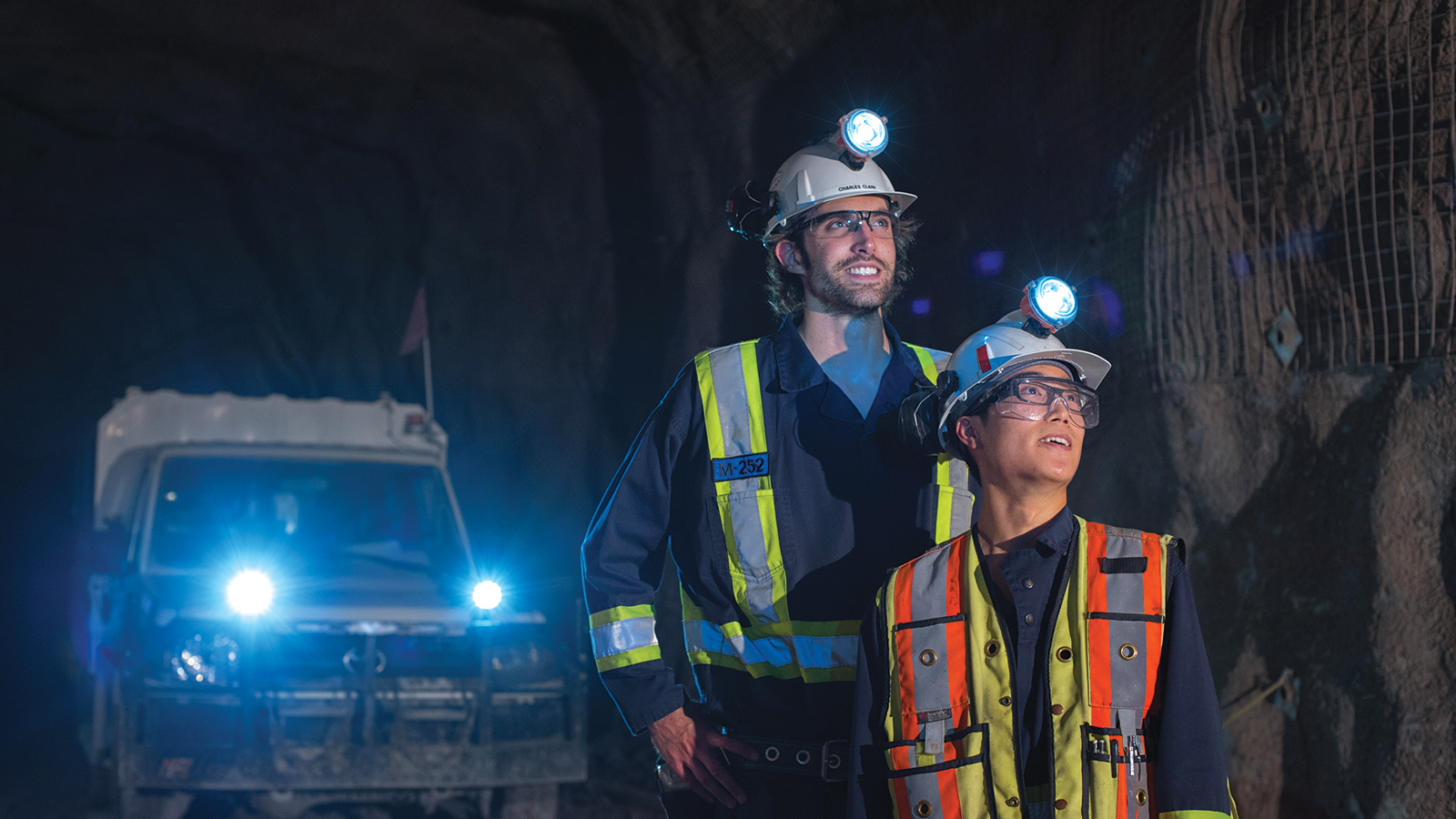
Mining engineers focus on finding ways to extract minerals or metals from the earth. Their expertise in mining, mineral processing, and mine waste management is highly sought after around the world, wherever mines are located. UBC’s Mining Engineering program integrates courses on engineering principles, earth sciences, and mining and mineral processing with content covering health, safety, management, economics, and environmental and social issues.
Program overview
- Campus
- Vancouver
- Program length
- 4 years
- Honours This option has additional requirements compared to those required in a Major specialization. Students must maintain high academic standing and may have to write a graduating thesis.
- No
- Co-op Co-op is an optional program where students alternate between academic terms and paid work terms. It’s an opportunity to gain relevant job experience while completing your degree.
- Yes
- Faculty
- Faculty of Applied Science (Engineering)
- Degree
- Bachelor of Applied Science (Engineering)
What you'll learn
Mining Engineering is concerned with the extraction and processing of ores containing valuable minerals or metals. To become a mining engineer, you need a thorough knowledge of general engineering principles, followed by the study of courses specific to mining and mineral processing. These courses are designed to cover a wide and diverse range of subjects in order to meet the challenges faced by the global mining industry. The program’s cross-disciplinary approach to mining is aimed at reducing the environmental impact of mining operations, improving the social impacts of mining, and increasing the efficiency of aspects of mineral extraction such as energy and water usage.
Campus features
UBC Coal & Mineral Processing Laboratory is fully equipped for teaching and research. The Department of Mining Engineering at UBC has made a commitment to foster responsible mining practices, and to produce mining engineers able to meet the complex challenges of sustainable approaches.
Courses
There are hundreds of courses you can take within Mining Engineering. Here are a few you might like.
Statics of particles, equilibrium or rigid bodies, rigid body statics and internal forces, trusses; kinematics: rectilinear motion; dynamics: Newton’s second law, friction, impulse, momentum, work and energy.
Focus on the interaction between society and the geologic environment. Locating, assessing and developing natural resources; understanding and preparing for natural hazards, design of structures and waste disposal sites.
Selection, design and development of underground mining methods based upon physical, geological, economical and environmental constraints. Underground materials handling (ore, waste, slurry, water) with equipment selection, production requirements, performance and costs.
Human relations in an organization; types of organizations; personnel evaluations and job rating systems; impact of manpower planning on decision-making; union negotiations; public relations; dealing with the media; corporate responsibilities to society and employees.
Outcomes
Your career opportunities will vary widely across a range of fields including mineral exploration, mine design and management, banking and venture capital, mining equipment and manufacturing, mineral and metal production and processing, environmental consulting, energy and utilities, technical sales and support, and others.
Take action & plan
Program requirements
Choose application type:
English-language requirements
English is the language of instruction at UBC. All prospective students must demonstrate English-language competency prior to admission. There are numerous ways to meet the English Language Admission Standard.
General admission requirements
IB Diploma Programme
- Completed IB Diploma, including at least three Higher Level courses.
IB Certificate Courses
- IB Certificate courses (Standard and Higher Level) may be used in an admissions average if you are graduating from a recognized high school curriculum that can be used as your basis of admission.
- IB Math Applications and Interpretations SL, or IB Math Studies, do not satisfy the math requirement for admission to UBC’s science-based programs, the Faculty of Management, the UBC Sauder School of Business, or the Vancouver School of Economics.
Degree-specific requirements: Applied Science (Engineering)
- IB Math Analysis and Approaches SL or HL, or IB Math Applications and Interpretations HL. (IB Math Applications and Interpretations SL, or IB Math Studies, are not acceptable.)
- IB Chemistry
- IB Physics
- Academically strong candidates missing either IB Chemistry or IB Physics may be evaluated on a case-by-case basis
Related courses
The following subject categories are particularly relevant for this degree. Consider taking courses in these areas in your junior year and senior year.
- Language Arts
- Mathematics and Computation
- Sciences
Want to get a feel for campus?
If you’re unable to visit UBC in person, or you just want to get a sneak peek at your new home campus before you arrive, take one of our virtual tours. Current UBC students walk you through UBC’s residences, study spots, recreational facilities, lecture halls, academic buildings, and more.
Related programs
Want to learn more?
Visit the Faculty of Applied Science (Engineering) website to learn more about Mining Engineering.
View full program detailsGet a post-graduate work permit for up to three years if you are a full-time UBC international student graduating from a bachelor’s degree program and meet all eligibility criteria.
Want to learn more?
Visit the Faculty of Applied Science (Engineering) website to learn more about Mining Engineering.
View full program details