Environmental chemists employ advanced analytical techniques and problem-solving skills to study the chemistry of air, water, and the Earth's surface.
Why this program?
- Learn on a tight-knit campus where you can work closely with professors and peers
- Get the skills required to work in one of the fastest-growing fields of science
- Have the opportunity to work on your own research or alongside professors on theirs
Program information
Send details- Campus: Okanagan
- Faculty: Irving K. Barber Faculty of Science
- Degree: Bachelor of Science
- Length 4 yrs
- Co-op Yes
- Honours Yes
Climate adaptation, natural resource development and emerging clean-technology demand skilled environmental chemists. The UBC degree in Environmental Chemistry provides students with a solid foundation across all subdisciplines of chemistry, along with core courses in environmental science, biology, and environmental chemistry.
Learn how to use advanced analytical techniques to detect and monitor environmental contaminants from smoke particulates to microplastics. Use problem-solving and teamwork to assess risk, inform policy, and remediation.
Experiential learning and research
The Irving K. Barber Faculty of Science supports student research through the Undergraduate Research Awards, which allow students to carry out their own projects over the summer months, and other awards, which provide opportunities to work with professors on their research.
You can also join the Environmental Chemistry Course Union to build friendships, get academic support, and gain increased access to career resources. In addition to having an active social schedule, the course union brings in speakers from industry and government to advise students on career opportunities.
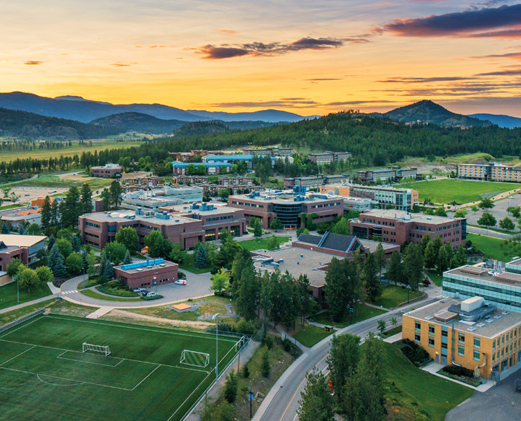
Life at UBC's Okanagan campus
UBC's Okanagan campus is renowned for its research opportunities and access to professors. On a tight-knit campus like the Okanagan’s, you’ll be able to work closely with award-winning faculty who are making meaningful strides in areas like the Earth’s carbon cycle, global warming, recovering valuable molecules and minerals from mine waste, and discovering neurotoxins produced by lake cyanobacteria.
Find out moreYour future
Graduates from the Environmental Chemistry program on UBC’s Okanagan campus are equipped for career opportunities with:
- Environmental consulting companies
- Environmental protection organizations in industry and government
- Public and private analytical laboratories
Program requirements
English-language requirements
English is the language of instruction at UBC. All prospective students must demonstrate English-language competency prior to admission. There are numerous ways to meet the English Language Admission Standard.
General admission requirements
IB Diploma Programme
- Completed IB Diploma, including at least three Higher Level courses.
IB Certificate Courses
- IB Certificate courses (Standard and Higher Level) may be used in an admissions average if you are graduating from a recognized high school curriculum that can be used as your basis of admission.
- IB Math Applications and Interpretations SL, or IB Math Studies, do not satisfy the math requirement for admission to UBC’s science-based programs, the Faculty of Management, the UBC Sauder School of Business, or the Vancouver School of Economics.
Degree-specific requirements: Science
- IB Math Analysis and Approaches SL or HL, or IB Math Applications and Interpretations HL (IB Math Applications and Interpretations SL, or IB Math Studies, are not acceptable)
- One of IB Biology, IB Chemistry, or IB Physics
- Grade 11 or equivalent Chemistry
- Grade 11 or equivalent Physics is strongly recommended
Note: Grade 11 Chemistry and Physics requirements listed are only relevant to students who are not completing the equivalent IB Diploma Chemistry and/or Physics courses.
For students studying outside of Canada, some examples of courses that may be accepted as Grade 11 equivalents are junior-level courses for American students, and IGCSE and O Level for those following British-patterned curricula.
Related courses
The following subject categories are particularly relevant for this degree. Consider taking courses in these areas in your junior year and senior year.
- Language Arts
- Mathematics and Computation
- Sciences